Tuesday, 5 February 2019

History of brushstrokes

Great video essay on the history of brushstrokes retracing the changes from the fast drying egg tempera technique requiring multiple layers of paint usually applied in cross hatching to obtain a soft look to bolder techniques with the adoption of slower drying oil starting with Titian and the use of dabbing, scraping, smoothing, scumbling and impasto painting.

The artists highlighted are :
- Jan Van Eyck
- Da Vinci and the Sfumato technique
- Titian
- El Greco and the use of hog hair bristle brushes to achieve bolder brushstrokes and palette knives and a comparison with Caraggio
- Rubens
- Velasquez and Hals
- Rembrandt
- Van Ruisdael
- Constable
- Turner


In the second part we are looking at the work of :
- Corot
- Manet
- Renoir
- Cezanne
- Seurat
- Van Gogh
- Gaugin and Cloisinism (outlines)


Part 3 will cover Sargeant and abstract contemporary artists:


Tips for Painting a Self-Portrait

Great tips for Painting a Self-Portrait extracted from

https://www.thoughtco.com/self-portrait-techniques-4038862

  1. Shape of your head: round, oval, squarish, thin, wide, etc.
  2. Angle and length of the jawline: pointed, round, or square
  3. Height of the forehead: distance from the eyebrows to the hairline
  4. Distance between the eyes: generally the distance between the eyes is the same as the width of an individual eye 
  5. Distance from the eyes to the side of the head: this is also generally the same as the width of one eye
  6. Depth of the eye sockets. You don't want your eyes to look like they are sitting on your face. It is important to get the lights and darks correct between the brow bone, the cheek bone, and the eye to convey a sense of the eyeballs seated in their sockets. 
  7. Shape and angle of the eyebrows
  8. Length and width of the nose. Generally the length of the nose from between the brows to the bottom of the nose is the same as the length of the ears. 
  9. Distance from the bottom of the nose to the mouth: this is about one-third of the distance from the bottom of the nose to the chin.
  10. Width and fullness of the mouth and lips
  11. Fullness of the cheeks and angle of the cheekbones
  12. The face is divided roughly into thirds with the hairline to the eyebrows being one-third, the eyebrows to bottom of the nose the next, and the bottom of nose to chin the next.
  13. The outer edges of the nose line up with the inner corner of the eyes.
  14. Generally the outer corners of the mouth line up vertically with your pupils.

The chemistry of colour

Great presentation of an exhibition that took place at the Indianapolis Museum of Art few years ago. The exhibition explains where colour pigments come from, from mineral to organic and ultimately synthetic.


Monday, 4 February 2019

Egg tempera technique

The Egg Tempera technique has been widely used up until the 15th century where it gradually got replaced by the use of oil as a binder instead of egg yolk. Egg Tempera offers water resistance and durability but could only be used on hard panels when oil finally allowed the application on canvas without cracking.

Here is a great video demonstrating how egg tempera paint is made :


Friday, 21 December 2018

Tim Gula - Proko - Reilly method demo

Proko just posted a video featuring Tim Gula who was the student of a direct student of Reilly which I have covered on this blog a while back (link below).


I will also use this opportunity to mention that the Reilly method is thoroughly demonstrated in the Proko caricatures demos by Court Jones., proof that you shouldn't discard some teaching because you have no interest in the type of art. Court shows how useful the Reilly method is to draw a portrait that looks "solid" and constructed, despite the apparent pushed shapes.


Related post:
https://moustachepaint.blogspot.com/2014/03/nathan-fowkes-and-reilly-method.html

Monday, 11 September 2017

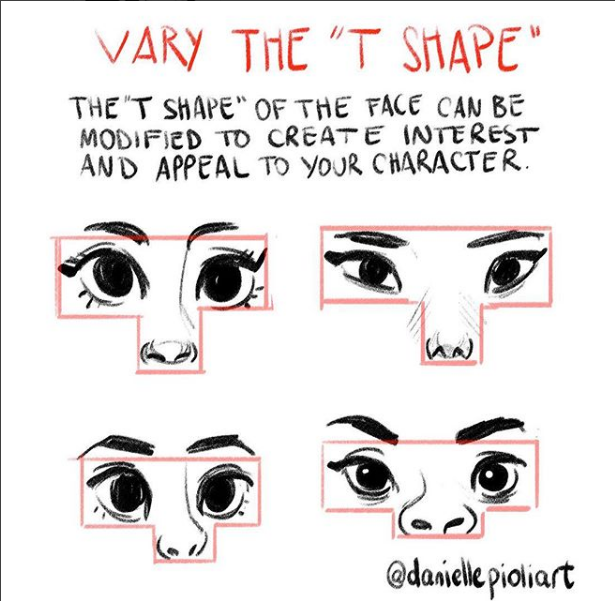
Varying the T shape

Danielle Pioli has a nice concept about facial proportions. The T shape is what I called the triangle on a previous post. Varying the proportions of the T shape will help you create different character designs


Related post:
https://moustachepaint.blogspot.fr/2017/01/facial-proportions-part-1.html

Thursday, 17 August 2017